
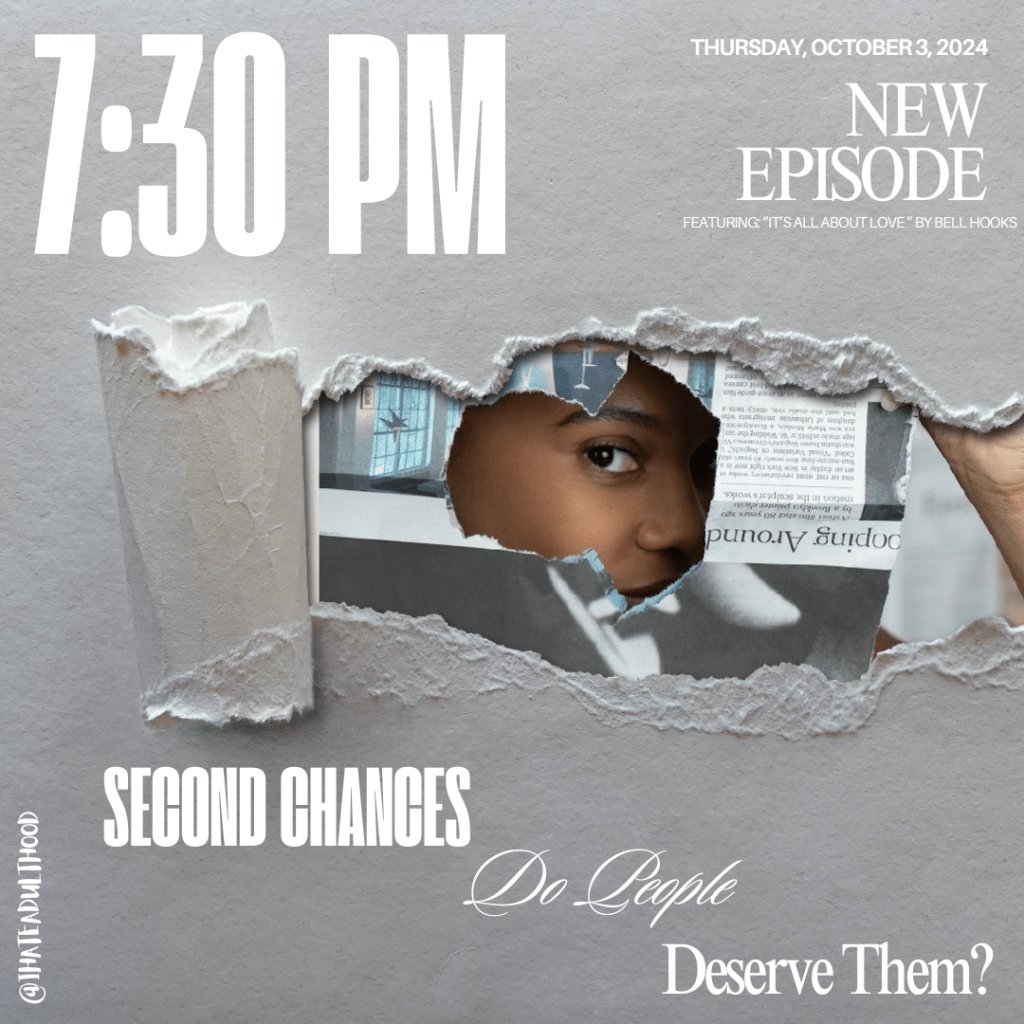
Do People Deserve Them?


Growing up, one way I solved problems in my life was by reading. I enjoyed brainstorming, researching, developing questions, and then hunting for the answer. I probably watched Nancy Drew movies thousands of times so that I knew how to crack the code on my latest issue.
Some of the questions I would try to solve were; “Why do humans do the things they do? Is love an act or a feeling? Do I always have to apologize? Can I unsubscribe from adulthood?”
Okay, maybe the last question was a joke. But it’s true. I would search the Internet for answers to the latest and most extraordinary phenomena, hoping to find a cure. My father once said, “Jadis, you should be a lawyer.”
Well, since that idea didn’t work out, I spent more time in Psychology and self-help books looking to solve my life’s greatest problems. And that’s exactly where our subject matter begins for today’s post, as we are going to talk about a transformative book that has answered many of the questions adults have tried to answer about love!
Bell Hooks, born Gloria Jean Watkins, is often revered as a prominent writer in our century. She has written tons of books on various genres. But, one of her most popular books is where we start our discussion for the evening, All About Love.
Bell poses many questions in her books, but for today, we are going to focus on two. I highly recommend reading the rest of the book.
The first question we will tackle is “Is Severing Bonds Necessary?”
Let’s paint the scene. Imagine you and a homegirl recently have fallen out. You have decided there is nothing she can do to fix the situation. After five years of friendship, you have decided it’s time to cut off all forms of communication. However, after a conversation with your grandmother, you find yourself stuck between a rock and a hard place.
Your grandmother asks, “Are you severing the relationship too soon? Would you not want a second chance to fix things if you were in her shoes?”
Don’t you hate it when grandma drops words of wisdom after we’ve already made our minds? Well, at least I do! But let me not get distracted, and return to the lecture at hand. We will deal with “our grandmother” later.
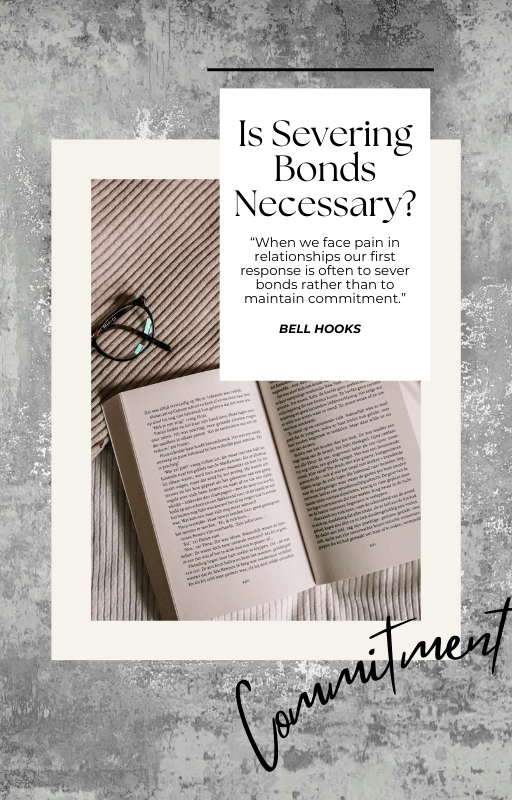
Hooks would agree with your grandmother’s questioning. She would say, “When we face pain in relationships, our first response is often to sever bonds rather than to maintain commitment” (Hooks, 1999, n.d.).
But are we taught what committing to someone or something means? What were we taught about the word commitment in our households while growing up?
Are we encouraged to stay together or remove access from ourselves to others every time an argument happens?
If we are not taught commitment or shown what it looks like on TV, Social Media, or books, how do we demonstrate it to others?
Hooks and Cambridge Dictionary provide their audience with a definition of commitment: “The fact of being willing to give your time and energy to something” (Cambridge Dictionary, 2024).
That definition is real BIG WORDS, so let’s break it down.
Commitment is the active choice individuals make to say “yes” when a mistake is made because it has five components: “care, responsibility, recognition, respect, and trust” (Hooks, 1999).
Even simpler, commitment is not giving up on the relationship when it doesn’t fit the “mold” you’re looking for but instead trying to figure out how to compromise without disparaging your values or boundaries.
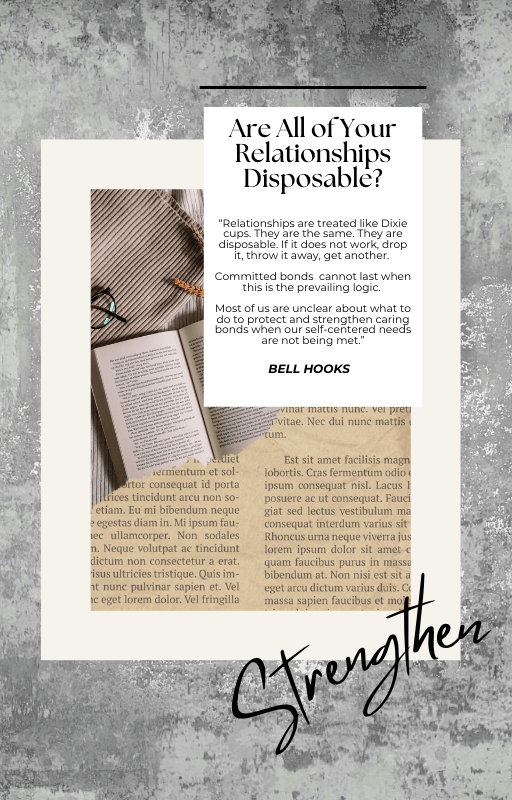
This brings us to the concluding question of our discussion on this beautiful evening: “Are all of your Relationships Disposable?”
Adult relationships often involve higher stakes and deeper emotional investments, yet for some reason, we are quicker to sever ties than to face the “real issues.”
Hooks reminds us that love is an active practice and that we should shift our focus from throwing away love to whether love can be practiced through forgiveness and understanding, even when mistakes happen.
Hooks states for all my bookworms, “Relationships are treated like Dixie cups. They are the same. They are disposable. If it does not work, drop it, throw it away, and get another. Committed bonds cannot last when this is the prevailing logic. Most of us are unclear about how to protect and strengthen caring bonds when our self-centered needs are not being met” (Hooks, 1999, n.d.).
As a result, we tend to compartmentalize or sometimes discard connections for self-endurance or convenience. But it’s not because the relationship cannot be fixed; instead, we don’t know how to give second chances to deserving individuals, so we run away.
Grandma might have been on to something when she said, “Are you giving up too easily?”
But maybe instead of getting stuck in her words and going down the defensive cycle, we should have asked, “How do I give a second chance to someone who has hurt me, but I don’t know how to mend it?”
That’s where we will conclude our conversation today with the HOW.
Ask yourself, “Do they know what they’ve done wrong? If so, have they taken responsibility?”
Assess the situation (i.e., List the pros and cons of giving a second chance)
Assess the other person’s willingness to change.
Ask yourself, “Are there boundaries I can set with this person to make me feel comfortable moving forward in the relationship?”
Act on the assessment completed and ensure that you’re not making a decision based on feelings but instead on “tangible evidence.”
Hooks’ depiction of second chances may fit where you’re trying to go in life, or it may not. You get to determine what works best for you.
But, I encourage you to think about how a second chance may allow a relationship to mend, forgiveness to be given, and the burden you carry on your heart to be released.
If you think second chances are needed, leave us a ❤️ below.
Peace & Prosperity,
Jadis DeShong-Venay
Sources:
Cambridge Dictionary Online. (2024 October 13). Commitment. https://dictionary.cambridge.org/dictionary/english/commitment#google_vignette
Hooks, B. (1999). All About Love: New Visions. Harper Collins.
 I Hate Adulthood
Leave a comment