

The Vicious Cycle of Toxicity: How To Stop Spreading It?
The word toxicity is often thrown around like a yo-yo stick. Or, one may say it is a word used like a broken record.
It repeats repeatedly throughout movies, songs, poems, and books, but people forget why that is.
It’s not because people are trying to be annoying. Instead, they are trying to bring awareness.
After watching Divorce in the Black this past week, I have been reminded constantly that toxicity isn’t always a habit that starts in adulthood but sometimes stems from childhood.
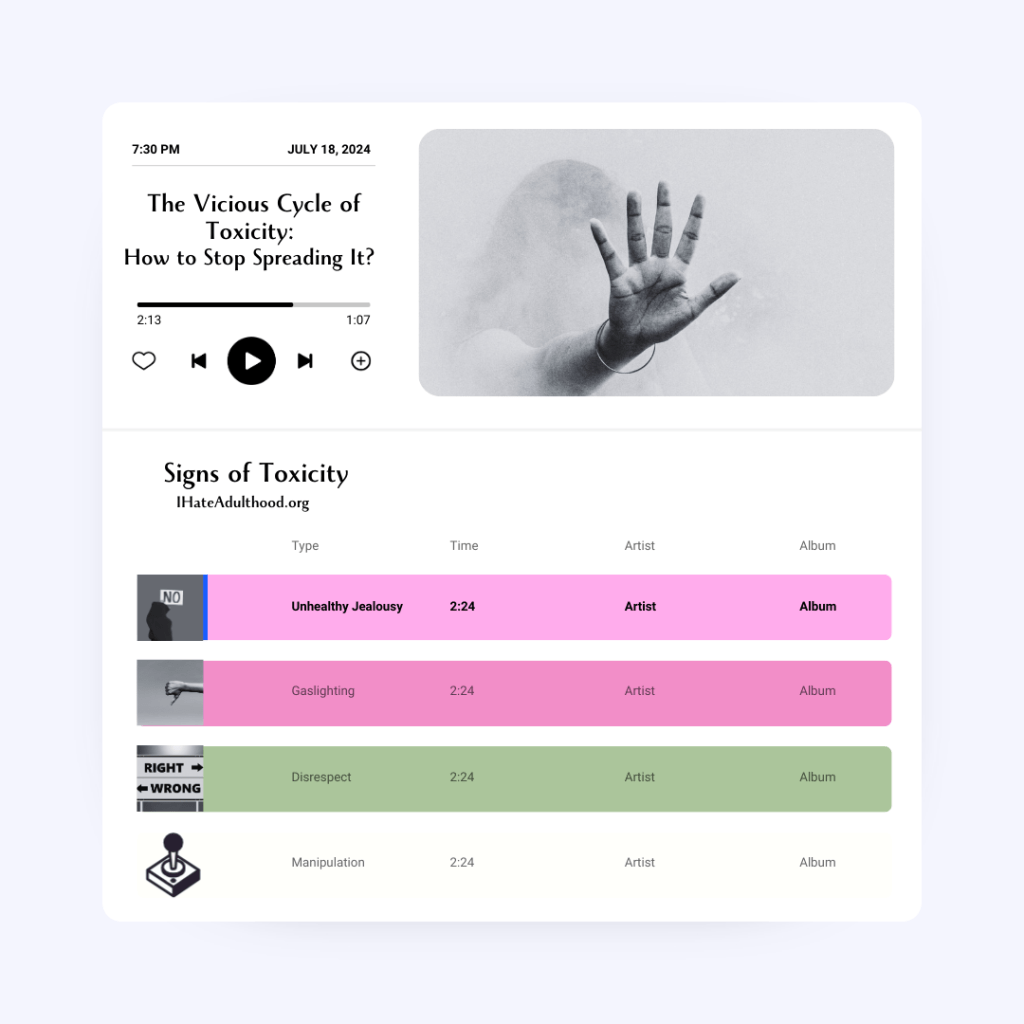
Unhealthy jealousy, gaslighting, disrespect, and manipulation don’t just miraculously appear. The signs of toxicity grow over time.
But how does one stop it? That’s where we will start our conversation this week, cracking the code on toxicity.
Because no one wants to live a life where every corner you turn, you are experiencing some form of harmful behavior.
For those who don’t know, a toxic relationship “tends to exhibit a pattern of negativity where at least one person causes harm in some way, whether purposeful or not” (Choosing Therapy, 2024).
And a toxic relationship doesn’t always involve a partner. One can experience toxicity with their roommates, friends, co-workers, bosses, and family members.
Toxicity often plagues individuals’ lives because it creates a cycle. This cycle includes days of happiness/peace/respect and other days of turmoil/arguments/punishment.
Therefore, the parties involved walk on eggshells, unaware of when the toxic behaviors will reappear, and worried that if they say the wrong thing, World War Three will begin.
Now that I have provided insight into how toxicity operates, I want to offer some support for stopping its spread.
#1: We have to take responsibility for the role we play in it:
Whether we are the person who participates in toxic behaviors or the person who receives them, we must acknowledge the role we play in the cycle of toxicity.
And I know that can be hard. But, if we don’t accept/acknowledge the patterns we help create, we cannot stop the sequence of events.
Instead, we are only following the pattern unconsciously or consciously, which leaves room for more destruction.
#2: We have to forgive ourselves:
We have to forgive ourselves for being a part of the cycle of toxicity.
Whether we were aware a year ago or learned today, we must forgive ourselves for what we did.
Life is too short to spend your time criticizing your past self for the decisions you made. We all learn with time.
And ladies, if you knew better, you would have done better.
So, pardon your behaviors; don’t excuse them, but give them grace.
#3: We have to be willing to try new things:
When we become aware of something, we often have difficulty knowing how to move forward in a positive direction.
We got stuck in the idea of how I do better, which sometimes leads us back to the same behaviors that caused the problem.
But here are a few things you can do to stop the cycle.
- Get help: There is no reason you must learn how to break cycles yourself.
- Apologize: Own your Shit!
- Learn Different Communication Strategies:How you communicate with others won’t work when you’re trying to do better.
- Figure out where the jealousy or unhealthy behaviors stem from: Take a look at your life; where did you start noticing these patterns?
- Remove access to people who can’t be on the journey with you: Sometimes individuals in our lives accept behaviors they shouldn’t; you don’t need those people as support.
- Be Honest with you: Keep it 100!
Toxicity is not something that can be avoided; it must be addressed.
However, addressing toxicity can also be scary because it is often normalized in our lives.
Or we hear statements from others encouraging us to stay in positions that no longer suit us, so we aren’t lonely.
We often forget that loneliness is only temporary and that some individuals are only supposed to be in our lives for a temporary moment.
Therefore, I encourage you to evaluate your life and determine whether there is toxicity in areas that are no longer conducive to your well-being.
If so, use some examples above as the foundational work to change things.
If not, use some of the suggestions above to raise awareness. Toxicity can manifest covertly in many places.
I love y’all, and we got this!
In the comments, how do you feel about our conversation today?
Do you agree? Do you disagree?
I will see you in our next discussion!
Peace and Prosperity, as always,
Jadis DeShong-Venay
References:
Tyler Perry. (2024). Divorce in the Black [Film]. Tyler Perry Studios.
 I Hate Adulthood
Leave a comment